
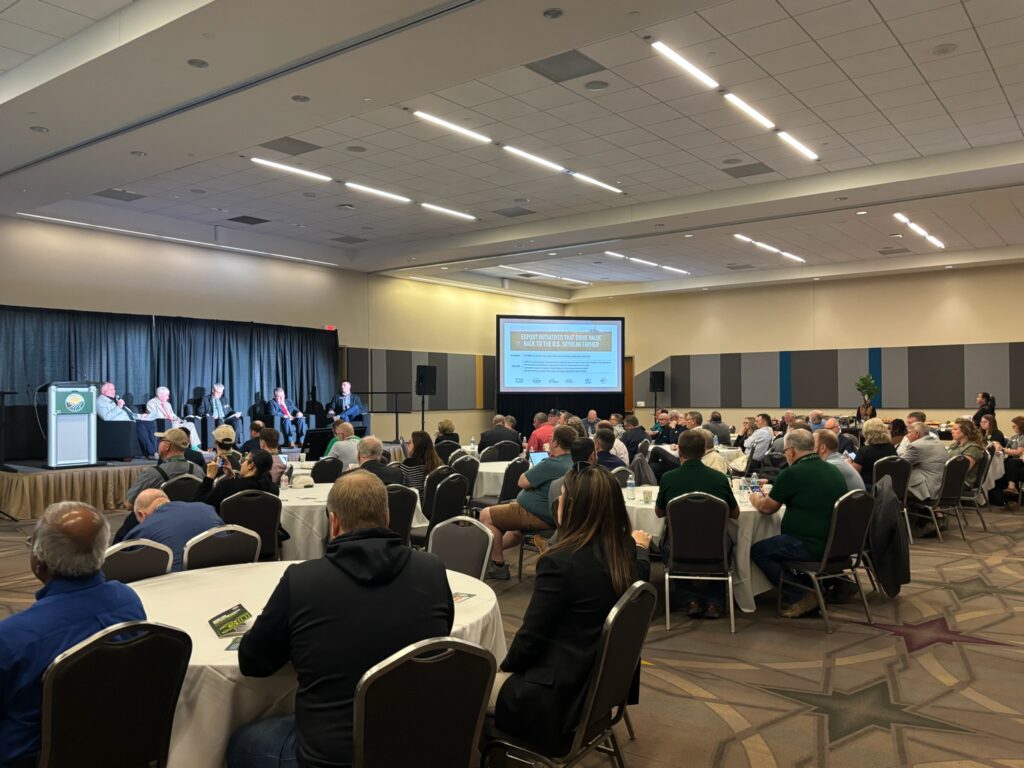
ASA’s World Initiative for Soy in Human Health program and the United Soybean Board hosted export partners at Commodity Classic 2026 for a panel on collaborative export initiatives drive value back to U.S. soybean farmers. WISHH executive director Gena Perry opened the session and welcomed attendees to the session, titled Export Initiatives that Drive Value Back to the U.S. Soybean Farmer. WISHH Chair Morey Hill joined Mike McCrainie of the U.S. Soybean Export CouncilJohn Hinners of the U.S. Meat Export Federation, Tony Mellenthin of the USA Poultry & Egg Export Council, and Tom Frisch, USB Secretary who moderated the panel.
The discussion highlighted how groups across the U.S. soy family work together to develop markets growing populations and rising incomes are increasing demand for protein. Through efforts that strengthen value chains, introduce new technologies and build long-term trade relationships, these partnerships help create new opportunities for U.S. soy exports across Asia, Africa, and Latin America.
“Frankly, it is simple,” said Morey Hill when responding to a question of why trade is a win-win for U.S. farmers and local economies. “For our farmers it is creating long-term, durable markets for U.S. soy. There is a reason that WISHH works long-haul to establish these trade avenues. It diversifies global demand with customers who understand U.S. soy while creating more food secure local economies.”
Hill also noted that Central Asia is a target area for WISHH in the new fiscal year. “We are really excited about Central Asia, which is part of our Trans-Caspian Plan, which aims to strengthen feed and food systems backed by U.S. soy across the region. You may recall that ASA/WISHH signed an MOU with the Republic of Uzbekistan framework for cooperation in areas such as animal feed, poultry, dairy, and aquaculture productivity, soy processing technology, quality standards, and nutrition innovation.”