
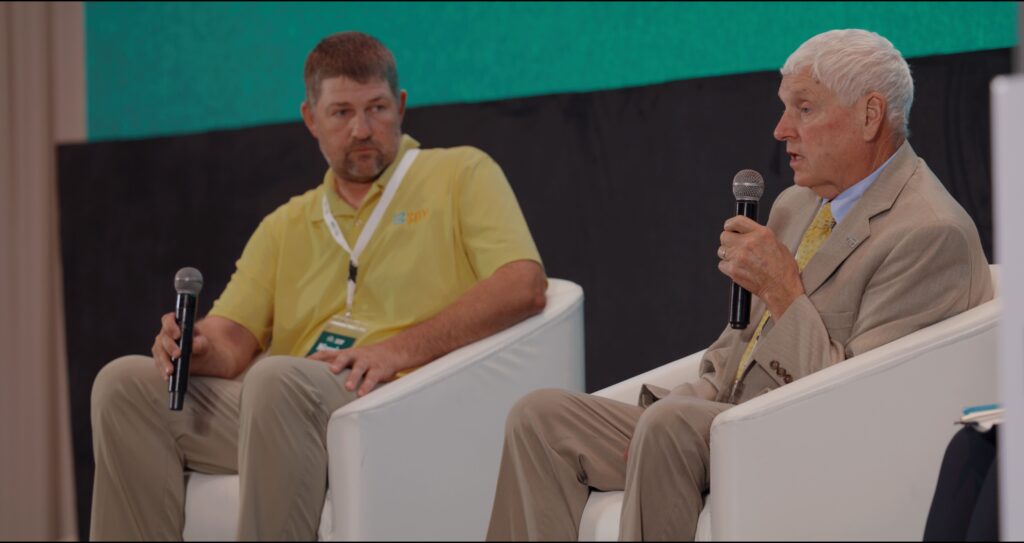
The ASA’s World Initiative for Soy in Human Health program showcased its work to boost the value of U.S. soy through Nigeria’s aquaculture industry at the U.S. Soybean Export Council’s annual Nigeria: Now conference in Lagos June 23rd. WISHH Chair Morey Hill joined USB ex-officio Brent Renner at a panel titled Growing Together: Advancing Nigeria’s Food Security through U.S. Soy moderated by WISHH executive director Gena Perry. The two Iowa soybean farmers explained how investments in industries like aquaculture in Nigeria create opportunities for more U.S. soy for feed while also advancing the local economy in Nigeria.
“WISHH and U.S. farmers are investing in Nigeria for the growth of Nigeria’s economy and food security because we believe that it will translate to growth of a stronger trade market for U.S. soy,” said Hill. “These things happen simultaneously.”
Hill and Renner also previewed WISHH’s Training Program for Young Professionals, which was the subject of the next panel.
“Youth are going to be the next wave of potential customers for the soy that we grow for its use for feed,” explained Hill.
TPYP helps create a new generation of leaders in aquaculture that could become trading partners for U.S. soy. The program strengthens the knowledge of the fisheries industry for young professionals by providing them with real world, on-farm training that showcases the latest technologies and best management practices.
Perry moderated the panel, Next Gens: WISHH and Nigeria’s Aquaculture Leaders, that included SejFarms CEO Sejiro Oke-Tojinu, Karma Feeds’ Lydia Taiwo, and Skretting Nigeria’s Seyi Adeleke-Ige.
“The TPYP program made me a competitive candidate for my job at Karma Feeds,” explained Taiwo in her opening remarks on the panel. “Now, I advise other fish farmers about soy utilization and feed formulation in an official capacity. It has been an important driver of business for our company.” Taiwo is a graduate of the United Soybean Board-funded TPYP program which Oke-Tojinu hosted at his fish farm.
Adeleke-Ige concluded the panel by telling the crowd of Nigerian business leaders that Skretting and other companies are grateful for the TPYP program as they seek the next generation of highly qualified aquaculture professionals.
The success of Skretting’s business and other businesses in Nigeria depend on trained youth,” said Adeleke-Ige. “We alone cannot do it, and that creates a win for farmers in the United States and Nigeria.”
Later in the week, a WISHH trade delegation got a close-up view of the fourth iteration of the TPYP program at SejFarms. Interns in a variety of fields explained how the program creates a linkage between formal, university training to on-farm training and why it makes them competitive for jobs in the future or makes their current role even more efficient. The group also saw feeding trials on the farm that compare high soy inclusion rates to other commercial feed.
“My final thought is that these are the type of programs that are a long-term investment in U.S. soy and it helps diversity our markets,” Renner, a USB Director, said to sum up the program.