
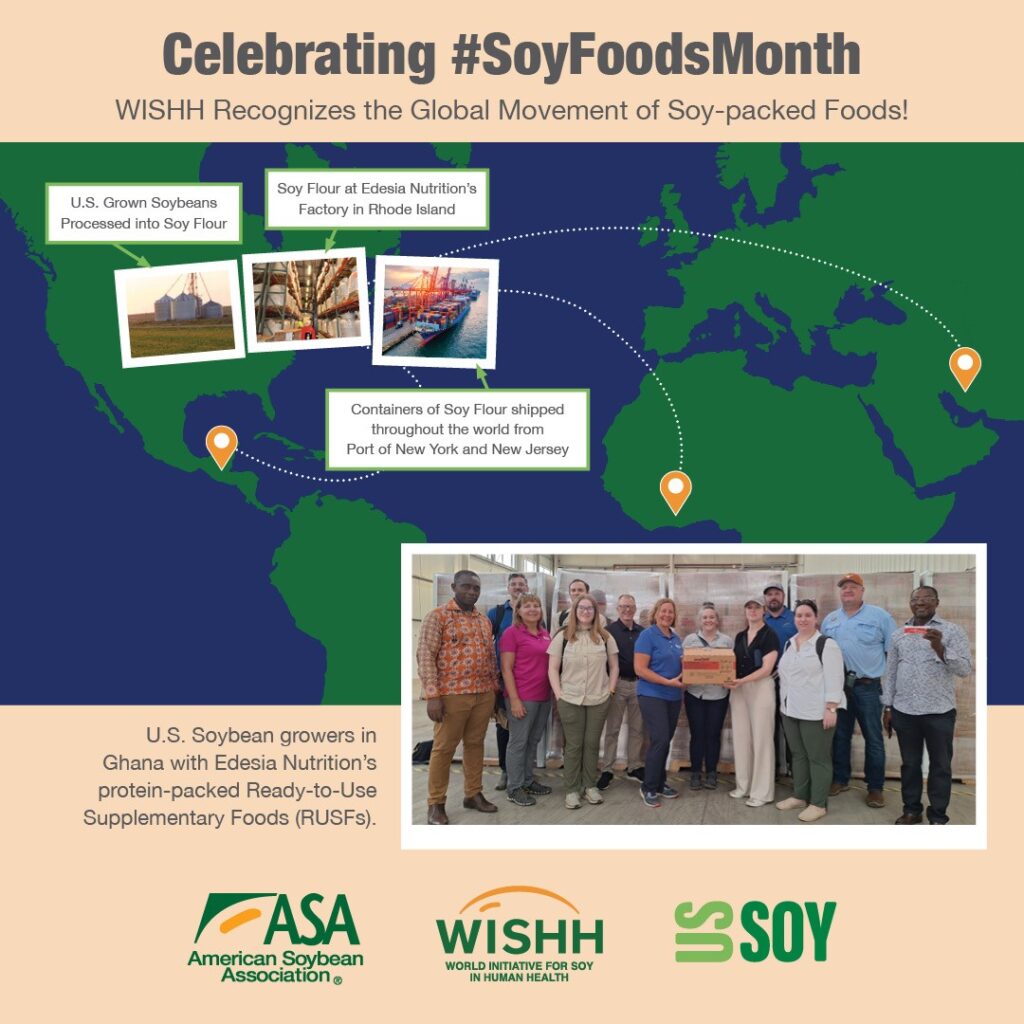
During Soy Foods Month, the World Initiative for Soy in Human Health is highlighting the impact of U.S. soybeans grown on American farms that reach more than 60 countries worldwide through high-impact nutrition in Ready-to-Use Therapeutic and Supplementary Foods (RUTF and RUSF) made by Edesia Nutrition. Their nutritious products – designed to meet the needs of malnourished children – are manufactured in Rhode Island with U.S. soy flour. From there, they are shipped out of U.S. ports to reach Edesia and its partners’ nutrition programs around the world, becoming another diverse use for U.S. soy.
Edesia’s use of U.S. soy flour in its nutritious products is projected to climb 87% over the 2022-2027 time period. WISHH partnered with Edesia on a United Soybean Board funded project to explore new usages for soy in its formulations. This Checkoff investment has resulted in a RUTF/RUSF that contains the highest level of soy that Edesia has ever used.
The organization values soy in its RUTF/RUSF for its high-quality protein and essential amino acids. The company expects to procure the equivalent of more than 230,667 bushels of U.S. soybeans in 2027, underscoring both the scale and importance of a reliable supply chain.
“We are getting shipments of soy flour all the time,” says Maria Kasparian, Edesia’s Chief of Staff. “Soybean farmers are key to what we do, as soy is a critical ingredient in the lifesaving products that we make.”
“Farmers definitely understand the need to have diverse uses for our crop,” added WISHH Committee Chair and Iowa soybean farmer Morey Hill. “WISHH’s work with Edesia aligns with our market development strategy and the fact that the countries where WISHH work are prioritizing and investing in food security.”
Edesia’s products are shipped from major U.S. export hubs, including the Port Authority of New York & New Jersey. They then land overseas in Edesia and partners’ warehouses, where they are distributed to populations across the globe.
Casting such a vast network means that these soy-based products also must meet logistical challenges. That’s why the soybean industry relies on close ties between farmers and transportation hubs throughout the journey.
“Transportation hubs like major ports are so meaningful to U.S. soy,” says Mike Steenhoek, executive director of the Soy Transportation Coalition. “Not only are they moving soy-backed products like Edesia’s, but they also move billions of bushels of soy for all our partners. It’s all part of creating a reliable and timely network.” Overall, U.S. soybean growers are contributing to high-impact food products while expanding markets for their crops but also reinforcing the global reputation of U.S. soy as a premium, reliable ingredient.